





MUSCAT, OCT 13
Listed companies and financial institutions in Oman face a major overhaul of their sustainability reporting practices as they prepare to comply with internationally recognised disclosure standards that become mandatory from January 1, 2029.
The transition, mandated by the Financial Services Authority (FSA), will require affected entities to strengthen their environmental data collection, climate-risk assessments, internal governance and reporting systems to meet increasingly rigorous international disclosure requirements.
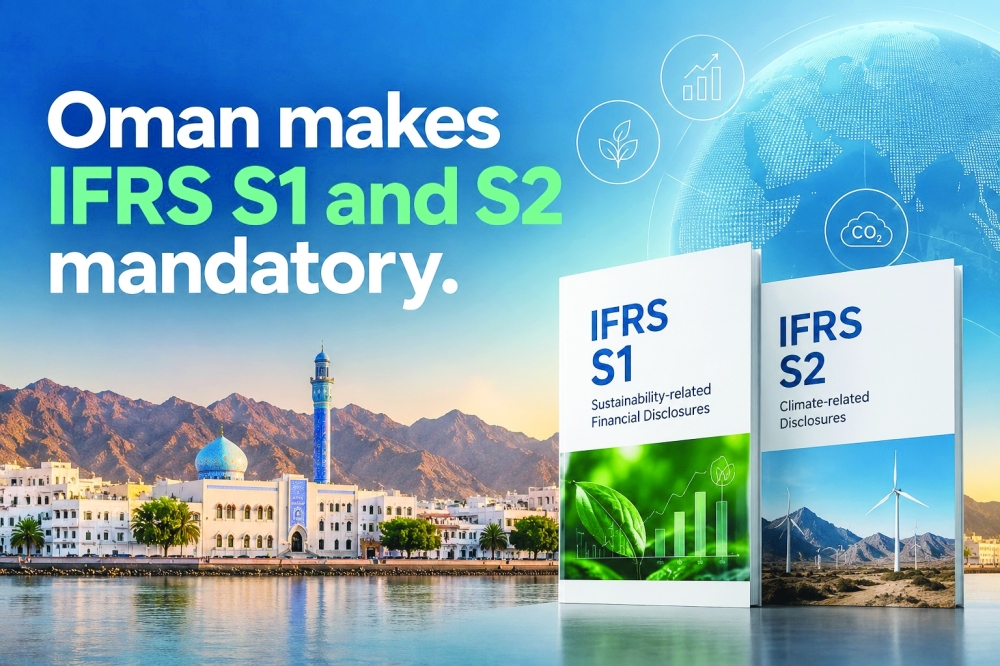
Under Decision E/7/2026, issued in March 2026, the FSA formally adopted IFRS S1 and IFRS S2, two sustainability disclosure standards developed by the International Sustainability Standards Board (ISSB), marking a significant step towards aligning Oman's corporate reporting framework with global practices.
IFRS S1 requires companies to disclose material sustainability-related risks and opportunities that could reasonably affect their financial prospects, including their implications for business strategy, governance and financial performance.
IFRS S2 focuses specifically on climate-related risks and opportunities, requiring disclosures covering climate governance, transition strategies, risk management and greenhouse gas emissions.
While full compliance becomes mandatory for annual reporting periods beginning on or after January 1, 2029, companies will need to begin preparing well in advance. The first annual disclosures covering the 2029 reporting year are expected to be published in 2030.
A further milestone falls on January 1, 2030, when Scope 3 greenhouse gas emissions disclosures become mandatory. These encompass indirect emissions across corporate value chains, including those associated with suppliers, transportation and the use of products and services.
For many Omani businesses, the transition will entail significant investments in sustainability data management, emissions accounting, internal controls and specialised reporting capabilities.
The FSA has also proposed a phased transition framework, potentially beginning with the 2027 reporting cycle, to help affected entities progressively align their existing sustainability disclosures with the new standards.
The proposed framework also envisages mapping existing environmental, social and governance (ESG) reporting metrics used by the Muscat Stock Exchange to the new international disclosure requirements.
Importantly, the transition represents more than a regulatory compliance exercise. It is expected to strengthen corporate transparency, improve investors' ability to assess climate-related financial risks and support capital allocation towards more sustainable business activities.
With the first mandatory reporting period approaching, companies will increasingly need to assess their preparedness, identify gaps in existing systems and establish credible sustainability data and governance frameworks well ahead of the 2029 deadline.
Oman Observer is now on the WhatsApp channel. Click here